
Blue Dream Strain: Effects, Flavor & THC Guide
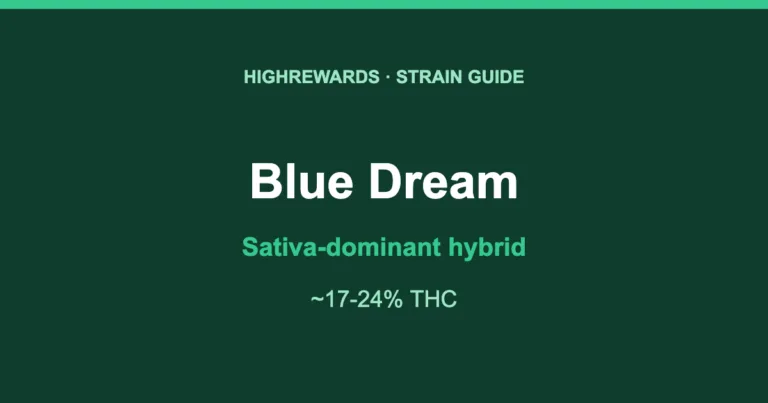
Blue Dream, at a glance, is sativa-dominant; the rest of this guide covers flavor, effects and THC content. Blue Dream is one of the most popular cannabis strains in the country, and for good reason. It pairs a sweet berry flavour with a balanced, easygoing high that suits all kinds of shoppers.
Quick facts
- Type: Sativa-dominant hybrid (around 60% sativa)
- Lineage: Blueberry x Haze
- Flavor: sweet berry, floral, earthy
- Typical THC: around 17 to 24%
What is the Blue Dream strain?
Blue Dream is a sativa-dominant hybrid, roughly 60% sativa and 40% indica, that emerged in Northern California in the early 2000s. It crosses Blueberry with Haze.
What are the effects of Blue Dream?
Users typically report an uplifting, creative head high paired with gentle full-body relaxation, which is why many reach for it during the day. Effects vary from person to person and product to product.
How does Blue Dream taste and smell?
Expect sweet berry notes up front, with floral and earthy undertones and an occasional peppery edge.
What is the THC level of Blue Dream?
Blue Dream usually tests around 17 to 24% THC, though it varies by grower and batch.
Earn rewards on your next Blue Dream pickup
Buying Blue Dream on your next dispensary run? Earn points on the purchase with HighRewards and redeem them for gift cards like Amazon and Starbucks. Here is how it works.
Blue Dream Use-Case Notes
Because sativa-leaning strains like Blue Dream tend to emphasize energizing, cerebral effects, it’s more often reported as a daytime or social-activity choice than a late-night one.
This article is for informational purposes only and is not medical advice.
Where Blue Dream actually comes from
Blue Dream is one of the few modern classics with no confirmed breeder. High Times devoted an anniversary feature to tracing it and came up empty. Ed Rosenthal confirmed only that it crosses Haze with DJ Short’s Blueberry. Which Haze remains argued over: some Santa Cruz growers insist on the original Haze Brothers line, while the genetics database SeedFinder lists Super Silver Haze and tags its own entry “probably.” Local legend places the first plants in the hills above Bonny Doon, possibly through a patient collective, but nobody has produced proof.
That murkiness matters at the counter. Growers have described two circulating cuts for years, one leaning sativa and one leaning indica, though phenotype variation is at least as likely an explanation as two genuinely different plants. Seed lines make it messier still. Humboldt Seed Organisation’s Blue Dream has four documented phenotypes, ranging from a short fast indica-leaning plant to a tall slow Haze-leaning one. Two people can open the same pack and finish three weeks apart.
Growing Blue Dream: flowering time, yield and difficulty
| Flowering time | 8 to 10 weeks indoors, averaging around 67 days |
| Indoor yield | Up to 430 g/m² per Leafly; seed banks claim 450 to 600 g/m² |
| Outdoor yield | Roughly 600 to 700 g per plant, harvested mid October |
| Height and structure | Tall, stretches hard through the first weeks of flower |
| Difficulty | Easy, and one of the standard beginner recommendations |
| Climate | 21 to 27°C days with a 8 to 11°C night drop, 40 to 50% humidity in flower |
Blue Dream earned its reputation with growers on throughput rather than forgiveness. It suits a sea of green layout, takes moderate to heavy feeding through veg, and finishes fast for something with this much Haze in it. The catch is the stretch. Growers routinely report plants doubling or more after the flip, and outdoor reports include two metre plants with a two metre spread and branches snapped by wind, so netting or staking is not optional outdoors.
- Powdery mildew and spider mites are the two pests most often flagged on this strain, which is why the 40 to 50% flowering humidity target matters.
- It feeds hungrily on nitrogen early, then wants that backed off from roughly mid flower. Growers describe it as finicky about both environment and nutrients despite the easy rating.
- Foxtailing has been reported in late flower, which loosens bud structure and costs density.
- Low stress training is the usual fix for height rather than late topping.
How Blue Dream compares to Gelato and Green Crack
Blue Dream sits in the same daytime lane as several strains already in this library, but the differences are concrete rather than cosmetic.
| Blue Dream | Gelato | Green Crack | |
| Lead terpenes | Myrcene, pinene, caryophyllene | Caryophyllene, limonene, myrcene | Myrcene, caryophyllene, pinene |
| Typical THC | 17 to 24% | 20 to 25% | Around 19% |
| Reported direction | Mostly energizing, creative | Mostly calming, body led | Sharply energizing |
| Grow difficulty | Easy, tall, high yield | Hard, short to medium, medium yield | Moderate, tall, fast |
| Main grower risk | Stretch and mildew | Bud rot in dense colas | Bud rot, needs trellising |
The sharpest split is agricultural. Leafly rates Blue Dream easy and Gelato hard, and Gelato returns a medium yield for that extra trouble. On flavour, Blue Dream is berry and pine while Gelato is pepper and citrus, so shoppers cross-shopping the two on price alone are buying two quite different experiences. Green Crack overlaps most closely on the energizing end but carries meaningful humulene that Blue Dream’s published profile does not.
What to look for when buying Blue Dream
Blue Dream carries a price premium that its potency does not always justify. Leafly’s site average is roughly $20 per gram, against about $12 for Gelato, and the THC bands overlap. You are paying for the name.
- Expect 17 to 24% THC on a menu. Anything advertised far above that is worth a second look at the certificate of analysis.
- A Leafbuyer and Trichome Institute analysis once called Blue Dream the most counterfeit strain in Colorado. Industry sources quoted by High Times argued the bigger problem was genuine Blue Dream grown badly in bagged soil, which strips the terroir out of the flavour.
- Good indoor Blue Dream has been described as having a translucent bluish tint to the buds and an unmistakable fruity blueberry nose. Flat green flower with no berry on the nose is a warning sign.
- Not every batch reads as berry. At least one seed line panel scored it as pepper, sweet lemon and pine instead, which reflects how far the name has spread across different genetics. Smell before you commit if the shop allows it.
Frequently asked questions
Is Blue Dream indica or sativa?
Blue Dream is a sativa-dominant hybrid, around 60% sativa and 40% indica.
Is Blue Dream strong?
With THC around 17 to 24%, it is moderately strong but known for a balanced, manageable high.
What does Blue Dream taste like?
Sweet berry up front, with floral and earthy notes and a hint of pepper.
What is Blue Dream’s lineage?
Blue Dream is a cross of Blueberry and Haze, which emerged in Northern California in the early 2000s.
What effects does Blue Dream produce?
It typically delivers an uplifting, creative head high combined with gentle full-body relaxation, making it a popular daytime choice.
Related Strains
Shopping for Blue Dream? HighRewards pays you back with real gift cards every time you visit a dispensary.
Turn Blue Dream into gift cards
Earn gift cards by earning rewards at any dispensary — and even liquor stores! Every purchase earns points you can redeem for gift cards to Amazon, Starbucks and more with the HighRewards app.


Scan now to download for FREE!


Explore more strains in the HighRewards cannabis strain library.