
Granddaddy Purple Strain: Effects, Flavor & THC Guide
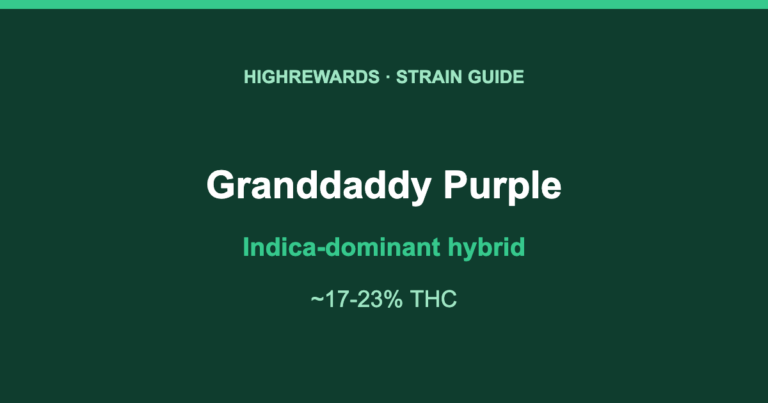
Here’s the gist: Granddaddy Purple is indica-dominant, with more detail on taste, effects and potency just ahead. Granddaddy Purple, often shortened to GDP, is a true cannabis classic. Created in California in 2003, it is famous for its deep purple colour, grape-and-berry aroma, and heavily relaxing effects.
Quick facts
- Type: Indica-dominant hybrid (around 70% indica)
- Lineage: Purple Urkle x Big Bud
- Flavor: grape, berry, sweet and earthy
- Typical THC: around 17 to 23%
What is the Granddaddy Purple strain?
Granddaddy Purple is an indica-dominant hybrid, roughly 70% indica and 30% sativa, bred by Ken Estes by crossing Purple Urkle with Big Bud.
What are the effects of Granddaddy Purple?
Users typically report a relaxing, calming experience that suits the evening and winding down. As an indica-dominant strain, it leans more toward body relaxation than energy. Effects vary by person and product.
How does Granddaddy Purple taste and smell?
Expect a sweet, fruity aroma of grapes and berries, with floral notes and hints of spice and pine in the smoke.
What is the THC level of Granddaddy Purple?
GDP usually tests around 17 to 23% THC, though it varies by grower, harvest and curing.
Earn rewards on your next Granddaddy Purple pickup
Grabbing some GDP soon? Earn points on the purchase with HighRewards and redeem them for gift cards like Amazon and Starbucks. Here is how it works.
Finding the Right Moment for Granddaddy Purple
Given its indica lean, Granddaddy Purple shows up most often in evening routines, think couch time, unwinding, or settling in before bed rather than tackling a busy afternoon.
This article is for informational purposes only and is not medical advice.
Where Granddaddy Purple actually comes from
Granddaddy Purple is usually credited to Ken Estes, who launched it in Oakland in 2003. Estes has said the plant came from a variety called Purple Medicine that was not grown commercially because it only yielded about a pound per light, and that it traced back to Pomo growers in Humboldt. The first pound, by his account, looked like Velcro. The name arrived when he caught himself calling it the grandpa of all weed and corrected to Granddaddy. Within a month there were lines around the corner, and he spent the next two years pulling out every other strain he had.
Estes was paralysed in a 1976 motorcycle accident and found cannabis as medicine during rehabilitation, which is worth stating because several secondary sources place that accident in the late 1990s. His own account is the earlier date. He was raided three times between 2005 and 2008 and did not win his federal case until 2018.
The genetics are genuinely contested. Estes attributes the strain to a blend of Mendo Purps, Skunk and Afghan. Much of the industry, including major strain databases, lists Big Bud crossed with Purple Urkle instead. Nobody has settled it, and it is worth knowing that the man who commercialised it is not generally credited with breeding it.
Growing Granddaddy Purple: flowering time, yield and difficulty
| Flowering time | 7 to 9 weeks, often cited as around 60 days indoors |
| Indoor yield | High for the plant size, roughly 450 to 540 g/m² |
| Outdoor yield | Around 540 to 595 g per plant, harvested early October |
| Height and structure | Short, 75 to 125 cm indoors, thick foliage and short internodes |
| Difficulty | Easy to moderate |
| Climate | 21 to 27°C at about 50% humidity, dry autumn essential outdoors |
This is a high yielding short plant, which is an unusual and useful combination. The trade is that the colas get large and heavy and the canopy is naturally dense, so airflow becomes the whole game.
- Growers are commonly advised to keep it indoors unless autumn where they live is genuinely dry, because the oversized colas rot readily if moisture is present.
- Clearing lower branches and pruning for circulation is the standard defence against powdery mildew and bud rot.
- It responds to high phosphorus feeding through flower, and takes well to training to lift yield further.
- Outdoors the bud weight can pull branches down, so support is worth planning for rather than improvising.
How Granddaddy Purple compares to Purple Punch and Northern Lights
Purple Punch is Granddaddy Purple’s own descendant, which makes it the most instructive comparison in the library.
| Granddaddy Purple | Purple Punch | Northern Lights | |
| Typical THC | 17 to 23% | Around 18% | 15 to 21% |
| Lead terpenes | Myrcene, pinene, caryophyllene | Caryophyllene, limonene, pinene | Myrcene, caryophyllene, limonene |
| Flavour signature | Grape, berry, violet, musky earth | Grape candy, blueberry muffin | Pine, earth, wood |
| Top reported effects | Sleepy, relaxed, hungry | Sleepy, relaxed, hungry | Sleepy, relaxed, hungry |
| Grow profile | Easy, short, high yield | Easy, short to medium, medium yield | Easy, short, 400 to 500 g/m² |
All three land in the same reported effect territory, so the real separation is aroma and agronomy. Purple Punch leads on caryophyllene and reads like candy, while Granddaddy Purple leads on myrcene and keeps a musky floral edge behind the grape. Granddaddy Purple out-yields both. Northern Lights is the safer pick in a humid climate, since it tolerates cold and pathogens far better than Granddaddy Purple’s heavy colas do.
What to look for when buying Granddaddy Purple
The purple here is genetic rather than a cold-shock trick, because the plant is genuinely high in anthocyanins. That is a useful thing to know, since plenty of flower is chilled late in flower to fake the colour.
- Expect 17 to 23% THC. By current standards this is a mid to upper-mid potency strain rather than a chart topper, and buying it expecting 30% will disappoint.
- Look for deep purple flower flushed with bright orange hairs under a heavy white resin dusting. Colour without resin is a cosmetic buy.
- Users describe it as a creeper that takes time to settle in, though not everyone agrees. If you are new to it, give it longer than you think before reaching for more.
- Genetic drift is a live complaint. Some consumers report modern versions losing the grape and picking up a grassy or metallic aftertaste. Estes himself has said today’s cannabis is not as good as his was.
Frequently asked questions
Is Granddaddy Purple indica or sativa?
It is an indica-dominant hybrid, around 70% indica and 30% sativa.
What is Granddaddy Purple good for?
Many users reach for it in the evening to relax and unwind, thanks to its calming, body-focused effects.
What does Granddaddy Purple taste like?
Sweet grape and berry, with floral notes and a touch of spice and pine.
Where did Granddaddy Purple come from?
It was created in California in 2003 by Ken Estes, who bred it by crossing Purple Urkle with Big Bud.
What is the THC content of Granddaddy Purple?
Granddaddy Purple typically tests around 17 to 23% THC, though this varies by grower, harvest, and curing.
Related Strains
HighRewards works at any partner dispensary, not just one — so wherever you find Granddaddy Purple, you can earn gift cards on the purchase.
Turn Granddaddy Purple into gift cards
Earn gift cards by earning rewards at any dispensary — and even liquor stores! Every purchase earns points you can redeem for gift cards to Amazon, Starbucks and more with the HighRewards app.


Scan now to download for FREE!


Explore more strains in the HighRewards cannabis strain library.