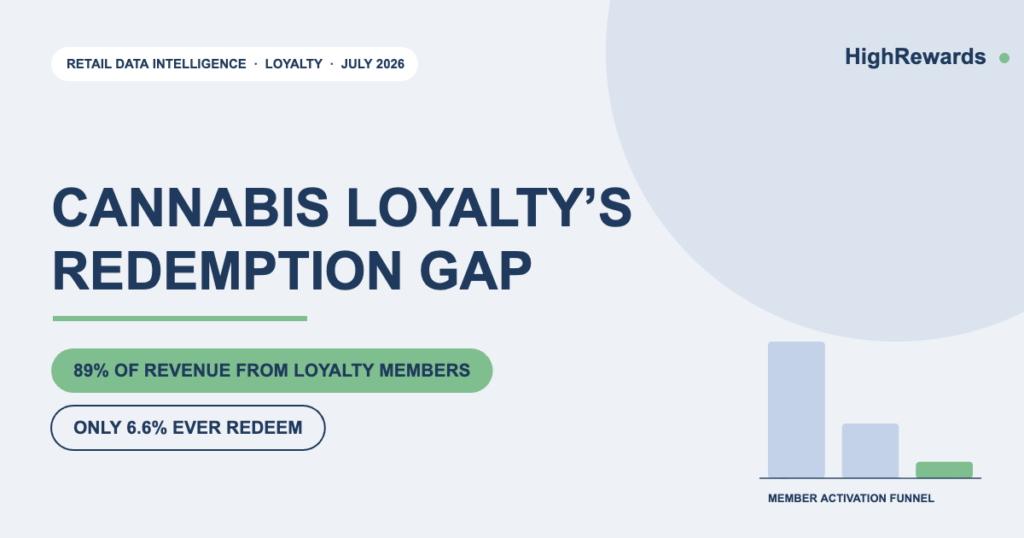
Cannabis loyalty members drive an estimated 89% of dispensary revenue. Yet only 6.6% of them ever redeem a reward. That gap, not the advertising bans everyone complains about, is the real growth lever most operators are leaving on the table.
Loyalty isn’t a nice-to-have anymore, it’s the acquisition channel
Cannabis brands can’t run ads on Google, Meta, or TikTok. Google blocks cannabis advertising outright, with only narrow topical hemp exceptions. Meta bans all cannabis ads in every state, legal or not. TikTok allows educational content but no paid promotion of anything smokeable or ingestible. That leaves SEO, organic social, referral, and the in-store loyalty program as the primary channels operators actually control.
Of those, loyalty is the one with a direct line to repeat revenue. Loyalty members purchase at more than double the rate of non-members, and industry data puts their share of total dispensary revenue at roughly 89%. When acquisition channels are this constrained, retention isn’t a retention play anymore. It’s the growth strategy.
The activation gap is where the money leaks
Here’s the problem: enrollment isn’t the bottleneck. Loyalty sign-ups are growing roughly 35% year over year across the category. The bottleneck is what happens after sign-up. Fewer than one in four new members ever earn their first loyalty point, and just 6.6% reach their first redemption. Most programs are collecting emails and phone numbers, not building habits.
That gap compounds. A member who never earns a point never opens the app again. A member who never redeems never associates the brand with a win. The program becomes a database instead of a behavior loop, and every acquisition effort behind that member has a much smaller shot at paying itself back.
What actually closes the gap
The operators who close this gap tend to do three things differently. First, they shorten the distance to the first point: a receipt scan or check-in at signup, not a purchase threshold buried three visits out. Second, they make redemption visible before it’s earned, showing members exactly what they’re working toward instead of a static points balance. Third, they treat the loyalty app as a retention channel in its own right, using push and in-app messaging the way other retailers use email, since it’s one of the only channels cannabis brands are allowed to fully control.
None of this requires new ad spend. It requires treating the loyalty program like the acquisition channel it already is, rather than a punch card bolted onto the POS.
For more on why paid channels are closed to cannabis brands in the first place, see our breakdown of why cannabis brands can’t advertise on Google, Meta, or TikTok. For a look at how this plays out at the market level, our Arizona wallet-share report shows how much revenue leaks to competitors even among loyalty-enrolled shoppers.
FAQ
Why can’t cannabis brands advertise on Google or Meta?
Google prohibits nearly all cannabis advertising, and Meta bans cannabis ads in every state regardless of local legality. Both platforms treat cannabis as a restricted good under their ad policies, independent of state law.
What share of dispensary revenue comes from loyalty members?
Industry data puts loyalty members at roughly 89% of total dispensary revenue, with loyalty members purchasing at more than twice the rate of non-members.
Why do so few loyalty members redeem rewards?
Most programs put too much distance between signup and the first earned point. Fewer than one in four new members earn a first point, and only about 6.6% ever redeem, which points to an activation problem rather than a lack of interest.
See where your loyalty program is leaking
HighRewards shows dispensary operators exactly where members drop off between signup and redemption, so you can fix the gap instead of guessing at it. Get a free HighRewards demo.