Marketing advisors who work across a handful of PE-backed portfolio companies see the same failure pattern on repeat: leadership greenlights an app or platform launch, engineering ships on time, and the go-to-market plan gets built in the final six weeks before launch instead of the first six. The result is a spike in downloads during launch week, a steep drop-off by week four, and a board asking why user growth isn’t compounding.
Distribution is a pre-launch problem, not a post-launch fix
By the time a product ships, the acquisition channels, retention loops, and activation metrics should already be tested, not designed from scratch. Waiting until launch to figure out where users come from and why they’d come back is the single most common reason PE-backed app launches stall inside their first 90 days.
This isn’t a product problem. Most of these apps work fine. It’s a sequencing problem: distribution planning starts after the build, when it should start alongside it.
The three-part fix
Advisors who get this right tend to build three things in parallel with product development, not after it:
- Retention infrastructure first. Loyalty, rewards, or re-engagement mechanics need to be live at launch, not bolted on in month three once churn data forces the issue.
- Channel testing before the launch date. Paid, organic, and partnership channels get validated with a landing page or waitlist weeks before the app exists, so launch-day spend goes toward what’s already proven to convert.
- Instrumentation from day one. Activation and retention events are defined and tracked before the first user signs up, not reverse-engineered from incomplete data after growth stalls.
What this looks like in practice
Cannabis retail makes the point sharply. Paid advertising on Google, Meta, and TikTok is largely off-limits to cannabis brands, which we’ve covered in detail, so retention and loyalty mechanics can’t be an afterthought the way they might be for a category that can just buy its way back into a user’s attention.
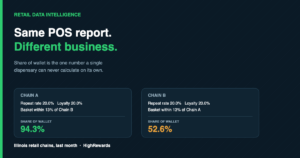
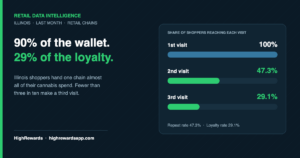
Operators who build repeat-visit infrastructure before launch consistently outperform those who treat it as a post-launch feature request. State-level market data backs this up too: even in a market still up for grabs, the chains gaining ground are the ones that built loyalty programs early, not the ones still catching up.
For PE-backed operators, the fix is organizational as much as tactical: give the go-to-market function a seat in product planning before the roadmap locks, not after.
FAQ
It means acquisition channels, activation metrics, and retention mechanics are tested and instrumented before the product ships, rather than being figured out after launch when growth stalls.
Because the initial launch spike, driven by press, an existing customer base, or a paid push, masks the absence of a repeatable acquisition and retention engine. Once that spike fades, usually within 60 to 90 days, there’s nothing built to replace it.
It should sit with whoever owns growth or marketing, with direct input into the product roadmap, not as a downstream function that receives a finished build and is asked to promote it.
Josh Lamb advises PE-backed operators and startups on marketing and go-to-market strategy, drawing on lessons from building HighRewards’ loyalty platform for cannabis retail. If your portfolio company has a launch coming up, get in touch before the roadmap locks.